
Jesus is Coming Back – Our Hermeneutics
Prologue
There are two major themes in the Bible: how to live a life that honors God and a record of history from the beginning of time to the judgment. The Day of the Lord is spoken of in both the Old and the New Testament. After the final judgment, when Satan is thrown into the lake of fire at the end of the millennial kingdom, John 14 2-3 ESV states “In my Father’s house are many rooms. If it were not so, would I have told you that I go to prepare a place for you? And if I go and prepare a place for you, I will come again and will take you to myself”. There is a beginning and an end to the creation.[i]
The Bible tells one story because it has one author! Revelation 19:10 ESV states, “For the testimony of Jesus is the spirit of prophecy.” 2 Peter 1:20-21 ESV “Knowing this first of all, that no prophecy of Scripture is from someone’s own interpretation. For no prophecy was ever produced by the will of man, but men spoke from God as they were carried along by the Holy Spirit.” We will focus our initial study on what Jesus tells us in the Gospels, Daniel and Revelations. The description of Jesus in Revelation and Daniels align; the Gospels record Jesus words in the flesh. [ii] (see Rev 1:13b-16, Dan 10:5b-6 for descriptions)
Eschatology and Hermeneutic
Definition: Eschatology literally means the study of end times prophecy. In the New Testament the Greek word ἔσχατος (eschatos) is used. Eschatos means “Last, final, utmost”. This word is the root of the English word “eschatology,” which is the study of the “last days” or the end times. In the Old Testament the Hebrew words “bə’aḥărîṯ hayyāmîm” is used, it means “in the latter days” or “in the last days”.[iii]
Definition: Hermeneutics refers to methods used for Biblical interpretation.
Our Hermeneutic
How you view interpretation affects your eschatology views. We believe in a literal face value interpretation unless clearly stated otherwise in the Bible. Further, we believe scripture does not contradict scripture. Therefore, if there appears to be a contradiction, the reader has the burden of studying scripture more carefully to resolve the issue.
Figures of speech and cultural idioms are used in the Bible and need to be understood as well as comparative language, substitutionary language, and amplification language. To accomplish this, we examine the context of the surrounding scripture and also use scripture to define scripture by conducting word searches in other passages in the Bible. This helps us to understand allegorical/symbolic text providing a deeper spiritual meaning and moral text which is viewed in the context of God’s law. Lastly, anagogical interpretations can be difficult to interpret. These include looking for hidden meanings using Hebrew letters as numbers –like mark of the beast 666. As such, care needs to be taken in using such methods.
- We believe that the 66 books in the Bible are divinely provided by God and the old and new testaments together provide all the information we need to have a saving relationship with Jesus Christ and to guide us in our Christian Walk.
- There are other texts outside of the Bible which supply historic, scientific and cultural context for examining the Bible such as 1st and 2nd century epistles written by early Christians. We may bring up other texts; however, anything that contradicts our current Bible, we do not consider authoritative text.
Bottom line: Bible should interpret the Bible: It does not violate itself, context is important
Jewish Hermeneutics – PRDS or PaRDeS
Jewish hermeneutics consist of four parts: 1) Peshat which is the simple or straightforward meaning, 2) Remez is the ‘hinted’ meaning of the text which is gained by following text to other parts of bible to reveal deeper insight, 3) Drush/Drash looks at the bigger picture to place scripture in context and takes multiple remezes to make a D’rash (a type of sermon), and 4) Sod which means ‘secret’ and is usually given by the Holy Spirit or an angel. We will not be using Sod but sticking to a literal interpretation of the Bible. Jesus used Jewish Hermeneutics in his teachings. Being God, he had access to all four levels. [iv] [v]
Bottom line: God’s Word is meant to be understood; we are encouraged to study it to fully understand.
Major views within Eschatology
Four (five) main eschatological views in Christianity
Idealism: Idealist believe Revelation does not contain prophecies of specific historical events. Instead, it uses symbols to express timeless principles concerning the conflict between good and evil.[vi] [vii]
Preterism: Preterists contend that New Testament Bible prophecy was fulfilled by the end of first century, and particularly through events of 70 AD when Jerusalem was sacked by Romans, although some see the fall of Rome in AD476 as significant. A modified view called Partial Preterism states that only the Second Coming of Christ, the resurrection of the dead and the final judgment remain to be realized at the End of Time.
Historicism: The Historicism approach attempts to associate biblical prophecies with historical events and identify symbolic entities with historical persons or societies – similar to Preterism, yet looking throughout history
Futurism: The futurist approach understands everything in the Revelation forward to be a prophecy of things that are to occur just before the Second Coming of Christ.
Eclectism: Eclectists pick and choose what they want to believe and are not anchored to any view. This approach emphasizes personal interpretation and understanding often using many other sources other than the Bible to draw their conclusions.
Millennial Rule – three major views
There are three unique vies on millennialism: Premillennial, amillennial and post millennial. Premillennialists believe Jesus comes prior to the millennial rule and sets up a literal earthly kingdom. This is a literal and the most interpretation, that is consistent with the Old Testament. Amillennialists believe there is no millennial rule but that Jesus rules from heaven; therefore, there is no earthly kingdom. This view can not be reconciled with Revelation/Daniel and the other prophets. Amillennialist consider everything symbolic. This presents many problems; the biggest one being ‘Did we miss Christ’s coming? No!’ Finally, there are the post millennialists who state that Christ will return after men change from hearing gospel. This view started around the 17th century when men believed the gospel would permeate through world like leaven, then Christ returns. The big problem here is ‘Do we really see the world getting better – No!’
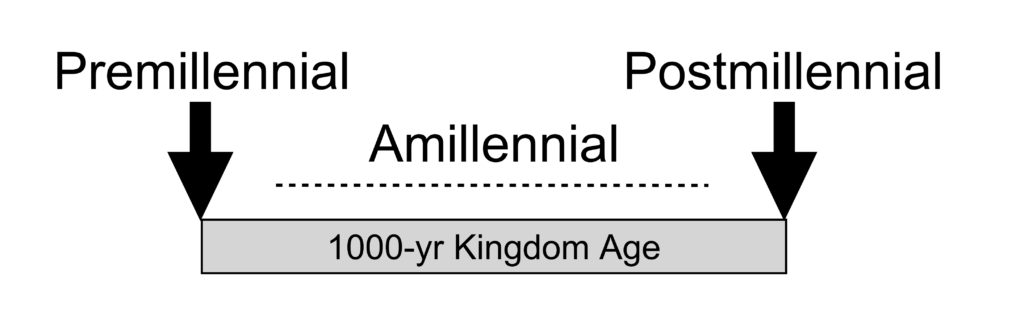
Our View: We are futurist and premillennialists.
Why We Believe in Futurism
First, it needs to be noted that there are competing tribulation concepts for a futurist view which we will address. But, for now, there are several main tenants which can be affixed to a futurist eschatological view.
- The Bible should be taken literally where appropriate.
Jesus literally fulfilled over 300 prophecies in the Old Testament (josh McDowell “Evidence that Demands a Verdict” is an excellent summary of the Bible for this statement). If a literal view was accurate for Jesus Christ’s first coming, then it logically follows it will be true for his second coming.
- Israel and the Church Distinct are two distinct entities with two distinct roles.
While all futurist agree on this, pre-tribulation folks believe the church is raptured before the tribulation. Mid and pre-wrath contend Christians do go through the tribulation even though tribulation is a continuation of God’s dealings with Israel. In Romans 11:25–27, Paul speaks of a future time when “all Israel will be saved.”
- In Matthew 24, Jesus, himself, talks about the end times and the order of events (covered in our episode on the Gospels, Episode X).
Jesus clearly states he comes after all events he described have occurred-the end of the tribulation. Revelations follows this same chronological series of events.
Tribulation and the Rapture
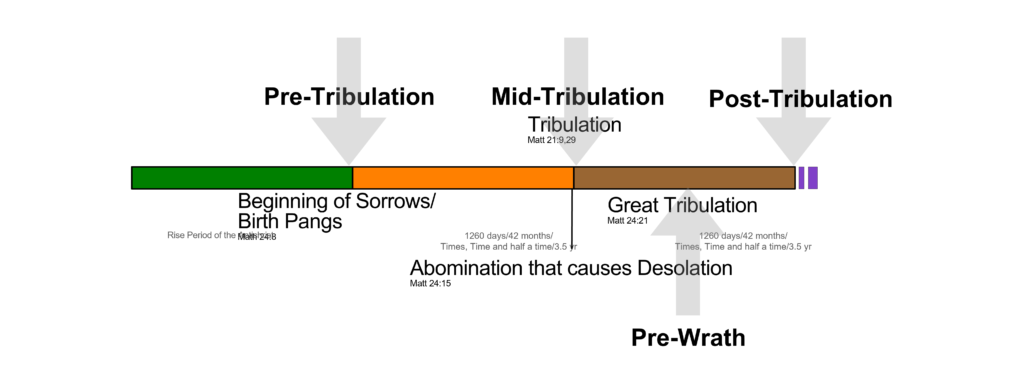
Tribulation used in the Bible to denote persecution; this is different from God’s Wrath which is the punishment for sin. Matthew 24:9 ESV “Then they will deliver you up to tribulation and put you to death, and you will be hated by all nations for my name’s sake.” This takes place prior to Daniel’s 70th week and up to the abomination of desolation (Matthew 24:15). At this point, the term Great Tribulation appears: “21 For then there will be great tribulation, such as has not been from the beginning of the world until now, no, and never will be.”. The great tribulation as described by Jesus is a specific time period which takes place between the desolation and Jesus’s 2nd coming.[viii]
The abomination that causes desolation is first mentioned in Daniel 9:27 ESV which states “27 And he shall make a strong covenant with many for one week, and for half of the week he shall put an end to sacrifice and offering. And on the wing of abominations shall come one who makes desolate, until the decreed end is poured out on the desolator.” (also, referenced in Daniel 11:31). Daniel 11:36 goes on to discusses the judgment: “And the king shall do as he wills. He shall exalt himself and magnify himself above every god, and shall speak astonishing things against the God of gods. He shall prosper till the indignation is accomplished; for what is decreed shall be done.”[ix]
The timing of the rapture is one of the more controversial in eschatology. There are four major views: Pre-Tribulation became popular in America around the 1830s with the work of John Darby; Mid-Tribulation viewpoint became popular around the 1940s by Norman B. Harrison. There are two more views that are very close but focus on whether believers come through the tribulation but before Jesus judges the wicked (post tribulation) or if believers are removed before the final trumpet/bowl judgments (pre-wrath).
No Man Knows the Hour
The Bible tells us to do two things as we approach the end times. The first is the concept of imminency. The idea that Jesus could come at any time, without warning, and that believers should live their lives as if they could die at any moment. The Bible uses phrases like “soon,” “quickly,” and “is near” to describe imminent events. The second command is to watch. The instruction to be ready for Jesus’ return, as taught by Jesus to his disciples. The Bible encourages believers to “keep watch” and “be ready” because it’s not possible to know when Jesus will
return. We may not know the hour but we are provided signs and a roadmap to the end.
The tribulation, rapture and the timing of these events is a central focus of the podcast and we will systematically examine the Gospels, Daniel and Revelations to show what scripture reveals using the two basic principles we discussed: literal interpretation of Bible is normally the best and the Bible does not contradict itself.
References
[i] Scripture quotations are from the ESV® Bible (The Holy Bible, English Standard Version®), © 2001 by Crossway, a publishing ministry of Good News Publishers. Used by permission. All rights reserved. The ESV text may not be quoted in any publication made available to the public by a Creative Commons license. The ESV may not be translated in whole or in part into any other language.”
[ii] Scripture quotations are from the ESV® Bible (The Holy Bible, English Standard Version®), © 2001 by Crossway, a publishing ministry of Good News Publishers. Used by permission. All rights reserved. The ESV text may not be quoted in any publication made available to the public by a Creative Commons license. The ESV may not be translated in whole or in part into any other language.”
[iii] Scripture quotations taken from the Complete Jewish Bible by David H. Stern. Copyright © 1998. All rights reserved. Used by permission of Messianic Jewish Publishers, 6120 Day Long Lane, Clarksville, MD 21029. www.messianicjewish.net.
[iv] Marty Solomon, Covered in his Dust website, Jewish Hermeneutics, (5 March 2015) https://makingtalmidim.blogspot.com/2015/03/jewish-hermeneutics.html accessed 14 April 2025.
[v] The Hidden Orchard Project, PaRDeS – Jewish Hermeneutics (10 July 2022) https://www.thehidddenorchard.com/peshat-pardes/ accessed 14 April 2025.
[vi] Preterism, Futurism, Historism, or Idealism? Reformed Classicalist Website (Jun 2024) https://www.reformedclassicalist.com/home/preterism-futurism-historicism-or-idealism accessed 10 January 2025
[vii] James M. Rockford, Evidence Unseen Website, Different Schools of Interpreting Revelation (2024) https://www.evidenceunseen.com/bible-difficulties-2/nt-difficulties/jude/different-schools-of-interpreting-revelation/ accessed 10 January 2025
[viii] Scripture quotations are from the ESV® Bible (The Holy Bible, English Standard Version®), © 2001 by Crossway, a publishing ministry of Good News Publishers. Used by permission. All rights reserved. The ESV text may not be quoted in any publication made available to the public by a Creative Commons license. The ESV may not be translated in whole or in part into any other language.”
[ix] Scripture quotations are from the ESV® Bible (The Holy Bible, English Standard Version®), © 2001 by Crossway, a publishing ministry of Good News Publishers. Used by permission. All rights reserved. The ESV text may not be quoted in any publication made available to the public by a Creative Commons license. The ESV may not be translated in whole or in part into any other language.”