
The Gospels Module 1
Prologue
Questions at the Temple
We will focus on Matthew 24 and Mark 13 which record a private discussion Jesus had with his disciples. In Luke 21, the conversation initially begins public but then moves to a private conversation. (orange shaded area is public conversation in Luke)
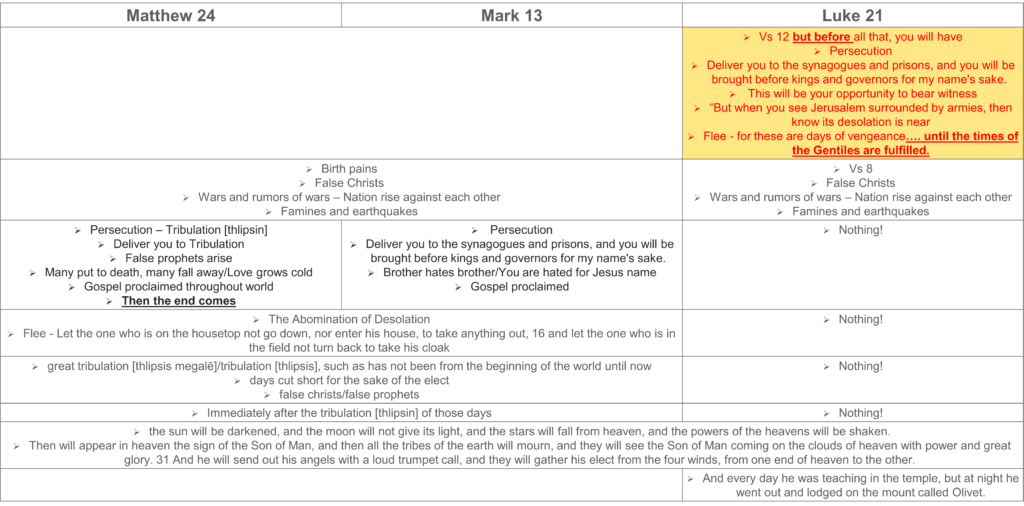
While on the Mount of Olives, Jesus had a private conversation with his disciples. We will begin by examining Matthew 24:3 and Mark 13:4 which have similar accounts. In Luke 21, care is needed to examine the answer gave in public and the one he gave in private to his disciples. We will primarily use Matthew 24 and compare and contrast Mark 13 and Luke 21 as required.
Luke 11 needs to be partitioned to fully understand context. Luke 11:5 sets the state for first conversation “5 And while some were speaking of the temple,”. It starts as a conversation about the temple and explains the end times. In Luke 11:12 note the transition “12 But before all this they will lay their hands on you and persecute you,” For the next 12 verses, we see a transition to the present until verse Luke11:24 which ends with destruction of temple in 70 AD and begins the age of the Gentiles (the present age prior to the tribulation.)” Then, from Luke11:25-28, the scripture reverts back to the tribulation period.
3 As he sat on the Mount of Olives, the disciples came to him privately, saying, “Tell us, when will these things be, and what will be the sign of your coming and of the end of the age?”[ii]
Matthew 24:4 – 14 provides a picture of events after the age of the gentiles a term used in Luke 21:24. Both Matthew and Mark are recorded as private conversations on the Mount of Olives with disciples, whereas Luke begins as a public conversation at the temple and then likely moves to a private one. Starting in Matthew 24: 15, a detailed chronological order of events is stated:
- Matthew 24:15 “abomination of desolation spoken of by the prophet Daniel”
- Matthew 24:21 “there will be great tribulation”
- Matthew 24: 24 “False Christ will appear “
- Matthew 24:29 “Immediately after the tribulation of those days the sun will be darkened, and the moon will not give its light, and the stars will fall from heaven”
- Matthew 24:30-31 “Son of Man coming on the clouds of heaven with power and great glory Send out his angels with a loud trumpet call, and they will gather his elect from the four winds, from one end of heaven to the other.”
Matthew 24:3 states “when will these things be, and what will be the sign of your coming and of the end of the age?” Mark 13:4 states “when will these things be, and what will be the sign when all these things are about to be accomplished?” and Luke 21:7 states “when will these things be, and what will be the sign when these things are about to take place?” The difference is that Luke 21 starts as a public conversation talking about near and far term events where verse 10 and 11 match passages on the end times but in verse 12, we see a departure to the present “But before all this they will lay their hands on you and persecute you.” Verse 24 ends the short-term prophecy and returns to a far term when it states “until the time of the gentiles is fulfilled.” After verse 24, it is likely Jesus is now in private with his disciples as in Matthew and Mark. Verses 12-24 in Luke very likely represent the 70AD fall of Jerusalem.[iii]
Time of the Gentiles
So, what is the time of the gentiles? Romans 11 states “25 Lest you be wise in your own sight, I do not want you to be unaware of this mystery, brothers: a partial hardening has come upon Israel, until the fullness of the Gentiles has come in. 26 And in this way all Israel will be saved, as it is written, “The Deliverer will come from Zion, he will banish ungodliness from Jacob”; 27 “and this will be my covenant with them when I take away their sins.” 28 As regards the gospel, they are enemies for your sake. But as regards election, they are beloved for the sake of their forefathers. From Romans, we can ascertain that the tribulation period will be a time when Israelites (as well as others) will have a chance to repent one last time and accept Jesus Christ as Savior.[iv]
Two views on Jesus Christ description of the End Times
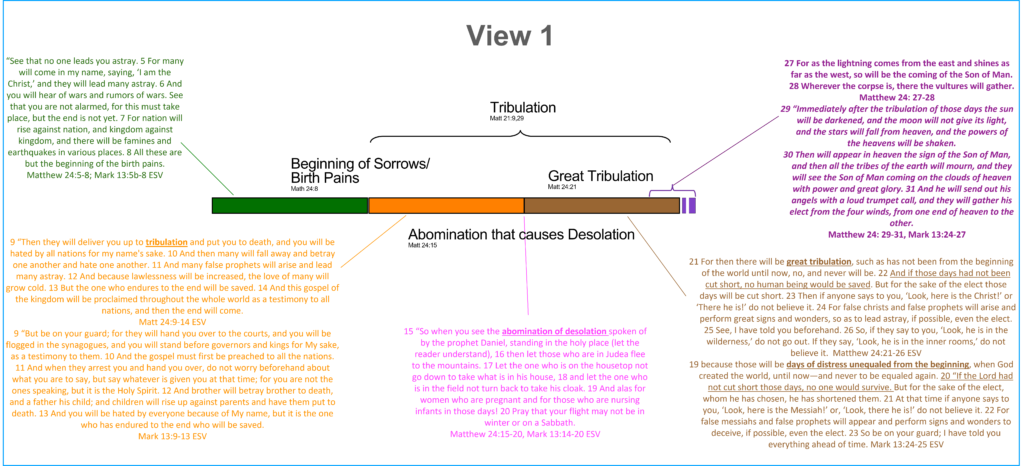
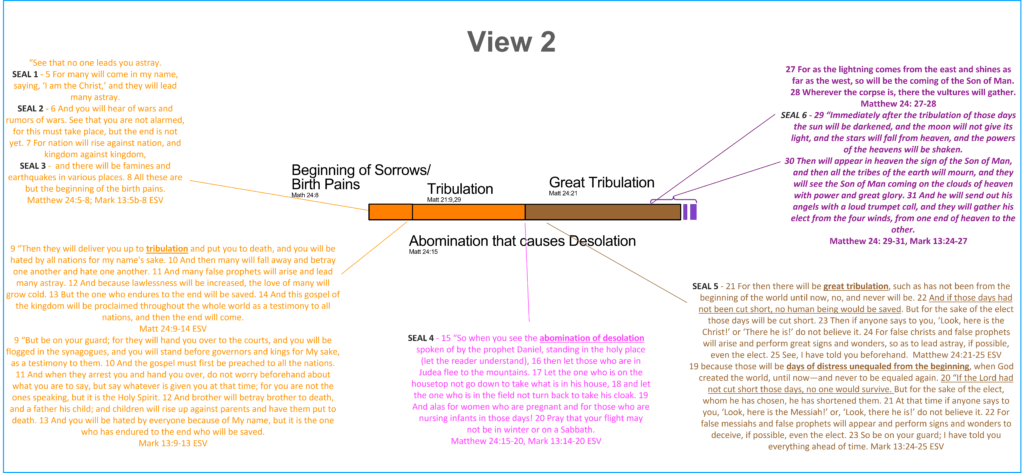
The first view considers the birth pains to occur prior to the 7-year tribulation period and the second view considers it to be the first half of the tribulation period.
View 1: birth pains occur prior to 7-year tribulation period[v]
View 2: Similar to view 1, but the birth pains occur within beginning of first three and a half years and align with the first 3 seals of Revelations 6.[vi]
Who are the elect and when are they gathered (Matthew 24:31)?
The term elect is used for three groups of people in the Bible. Jews, gentiles and angles. In short, God calls the elect and the elect are those that follow and obey him. For Christians, those that put their faith in Jesus Christ—we are the elect. God calls us to him, we must follow.
- Jews: ROMANS 9:10-12 ESV “…in order that God’s purpose of election might continue, not because of works but because of him who calls…”
- Gentiles: ROMANS 11:6-8, 27-29 ESV “28 As regards the gospel, they (the gentiles) are enemies for your sake. But as regards election, they are beloved for the sake of their forefathers. 29 For the gifts and the calling of God are irrevocable.”
- Angels: 1 Tim 5:21 ESV “In the presence of God and of Christ Jesus and of the elect angels…”[vii]
Epilogue
The gospels are clear. The elect (believers) are gathered after the abomination of desolation.
References
[i] Scripture quotations throughout this document are from the ESV® Bible (The Holy Bible, English Standard Version®), © 2001 by Crossway, a publishing ministry of Good News Publishers. Used by permission. All rights reserved. The ESV text may not be quoted in any publication made available to the public by a Creative Commons license. The ESV may not be translated in whole or in part into any other language.”
[ii] Ibid
[iii] Ibid
[iv] Ibid
[v] Ibid
[vi] Ibid
[vii] Ibid