
The Parables Module 1
Prologue
Parables in the Bible are stories told by Jesus to teach those he talked to and his disciples. We will examine three main questions: 1) Which parables relate to the end times?, 2) Do they tell a consistence story? And 3) Do they align with what Jesus told his disciples? The gospels provided us a framework for the end times, we will see if the parables agree.
Summary of Parables
Parables can be loosely categorized into several major themes: Kingdom, Eschatology, Living for/Loving Jesus; Seeking Lost; Forgiving; and Judgement.
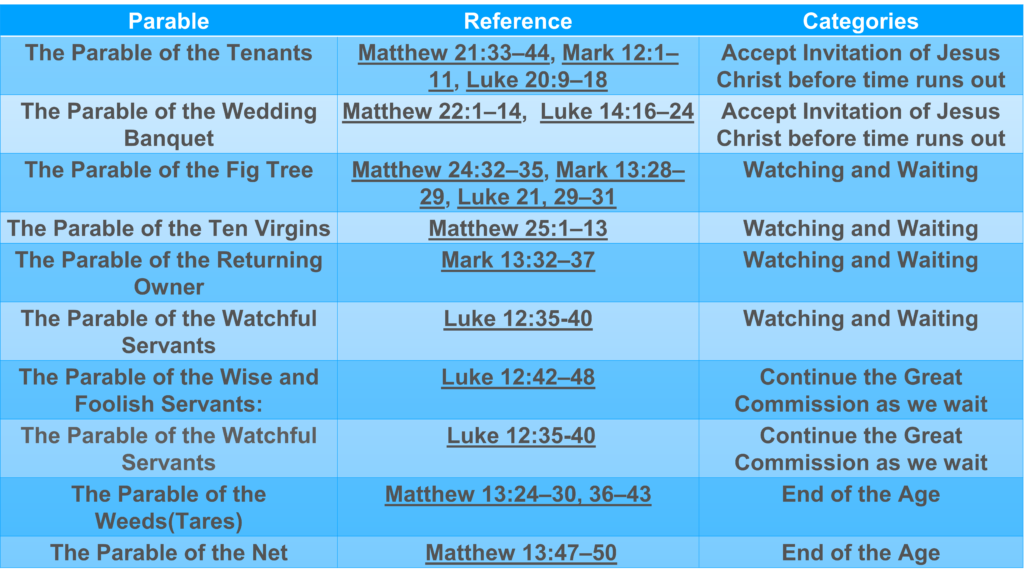
Accept Invitation from Jesus Christ before time runs out
The Parable of the Tenants Matthew 21:33-44
[I] Jesus told this parable to the chief priest and elders at the temple in Jerusalem. The vineyard represents Israel, the tenants are the priest and the servants/son are the prophets and Jesus. The parable is directed at the leaders and tells us the penalty for rejecting the salvation message of Jesus Christ. Jesus gathers his elect at the end times, but the final judgement for those who reject him is severe.
This parable is very similar as told Dan 2. In Daniel 2:34 “As you looked, a stone was cut out by no human hand, and it struck the image on its feet of iron and clay, and broke them in pieces.” [i] The Parable of the Tenet is directed at the Jewish leaders who are in rebellion, Dan 2:34 is directed to worldly leaders in rebellion. The rebellious will be destroyed by Jesus Christ.
The Parable of the Wedding Banquet Matthew 22:1–14
Jesus shares this parable while dining at the house of a prominent Pharisee. A rich man invites many people to a wedding feast but many wind up making excuses and do not come. There is a sense of urgency in the request, since the man said come everything is ready. This represents the imminency of the request while the man represents Jesus Christ given us an invitation to the feast. When the initial guests decline the invitation (representing those in Israel that are self righteous), the invitation goes out to the poor and cripple (representing those in Israel that were cast by the side the self righteous, and the gentiles, the foreigners that God told them to take His word to in the Torah). He lastly goes out and tells his servant to go out and tell people to come in (the great commission).
We are told to do both. We need to be ready and work till the end, it is a choice to follow Jesus Christ. Are you sure of your salvation? We are to abide in Him! If you willfully disobey, you will be judged harshly.
The man who would not put on the wedding clothes was not willing to accept Jesus as King. You don’t make the terms, it is a free gift, but He dictates the terms. It shows this man had a rebellious heart and would not be conformed to Jesus, a key part of sanctification.
Watching and Waiting (imminency)
Watching and waiting (imminency) are two major concepts used in the New Testament. Imminency relates to the idea that Jesus could come at any time, without warning, and that believers should live their lives as if they could die at any moment. The Bible uses phrases like “soon,” “quickly,” and “is near” to describe imminent events. We are told to watch so we are ready for Jesus’ return, as taught by Jesus to his disciples. The Bible encourages believers to “keep watch” and “be ready” because it’s not possible to know when Jesus will return.
The idea of Imminency is that Jesus could come at any moment, the command to watch is a call to be ready for His return. These ideas are not mutually exclusive. The parable of the wedding banquet
The Parable of the Fig Tree (Matthew 24:32–35 ESV, Mark 13:28–29, Luke 21, 29–31)
“32 “From the fig tree learn its lesson: as soon as its branch becomes tender and puts out its leaves, you know that summer is near. 33 So also, when you see all these things, you know that he is near, at the very gates.” Jesus just provided us in Matthew 24 the things we should watch for and now he tells us to watch; this was covered in the gospel presentation.
The Parable of the Ten Virgins Matthew (25:1–13)
The parables of the ten virgins represent both watching and imminency. Ten virgins await the bridegroom but only five were prepared with extra oil for when he arrived. We do not know exactly when Jesus Christ will return so we must be ready (accept him as savior) and watching for his return. We must be actively growing in our faith and be ready for the tribulations when they arrive.
The Parable of the Returning Owner (Mark 13:32–37)
We, like the servants to the land owner, need to be living our lives for Jesus as if he may return at any moment. (Imminency) We must live our lives actively serving and doing the will of God.
The Parable of the Watchful Servants (Luke 12:35-40)
This parable describes servants who await the return of their master and should be prepared to greet him when he returns. The example is clearly to live our lives as if Jesus may occur at any time and to be watching for his return. Both imminency and watching are implied. The title of the parable, itself, tells us to watch and the last sentence tells us “…you must be ready.”.[ii]
The Great Commission
The Great Commission Matthew 28:18-20 ESV
18 And Jesus came and said to them, “All authority in heaven and on earth has been given to me. 19 Go therefore and make disciples of all nations, baptizing them in the name of the Father and of the Son and of the Holy Spirit, 20 teaching them to observe all that I have commanded you. And behold, I am with you always, to the end of the age.”[iii]
The great commission has two parts: lead people to Jesus Christ and disciple them! Jesus tells us this job will not be easy and that even family and friends may turn against us (Luke 12:49-59). So then, what parables does Jesus provide us to explain our responsibilities?
Parable of the Returning Owner & Parable of the Wise and Foolish Servants Luke 12:42-28
Jesus explains in this parable that the wise servant who knew his master’s will is the one who does the master’s will even when his master is not there to watch. The servant who knows the will of the master and refuses to do and even abuses those over whom he has authority will be punished severely.
The Parable of the Persistent Widow Luke 18:2–8 ESV
The last verse of this parable says it all – “Nevertheless, when the Son of Man comes, will he find faith on earth?”[iv] We are the persistent widow and we need to be exercising our faith and providing our witness to the world until the Lord’s return.
The End of the Age
What is the end of the Age and what will happen?
Two verses in the New Testament talk about the end of the age: Luke 21:24 ESV “Jerusalem will be trampled underfoot by the Gentiles, until the times of the Gentiles are fulfilled” and Romans 11:25 ESV “A partial hardening has come upon Israel until the fullness of the Gentiles has come in.” We are currently in the age of the gentiles which is also called the church age. Jesus tells us what will happen at the end of the age.[v]
Parable of the Weeds Matthew 13:24–30, 36–43 ESV
Jesus tells us in the parable “Gather the weeds first and bind them in bundles to be burned, but gather the wheat into my barn.” He then explains to his disciples that the son of man will send his angels to gather all the law beakers and throw them into the fiery furnace but the righteous will be with their Father. This emphasizes what he said in Matthew 24:31 where he states he will send his angels to gather the elect. [vi]
Parable of the Net Matthew 13:49-50
In a similar parable as above with the weeds. Jesus uses an example of hauling in all sort of fish in a net but then throwing out the bad ones. As above, we have one harvest of the world with judgement for the wicked occurring at the same time as saving the righteous.
Epilogue
The parables teach us that all paths go through Jesus. If you won’t accept Jesus, you will be removed from the Kingdom. He is not coming at a time of our choosing. We need to be ready and work till the end, it is a choice to follow Jesus Christ. We are to abide in Him (imminency)! If you willfully disobey, you will be judged harshly. We are to Watch, He told us what to look for! This generation will not pass away until all these things take place. The Harvest is at the End of the Age that is the Age of the Gentiles or the Church Age as some call it.
References
[i] “Scripture quotations throughout this document are from the ESV® Bible (The Holy Bible, English Standard Version®), © 2001 by Crossway, a publishing ministry of Good News Publishers. Used by permission. All rights reserved. The ESV text may not be quoted in any publication made available to the public by a Creative Commons license. The ESV may not be translated in whole or in part into any other language.”
[ii] Ibid
[iii]Ibid
[iv] Ibid
[v] Ibid
[vi] Ibid